
KMTC Pharmacy graduates are not licensed pharmacists. Here's why
 KMTC Student Hub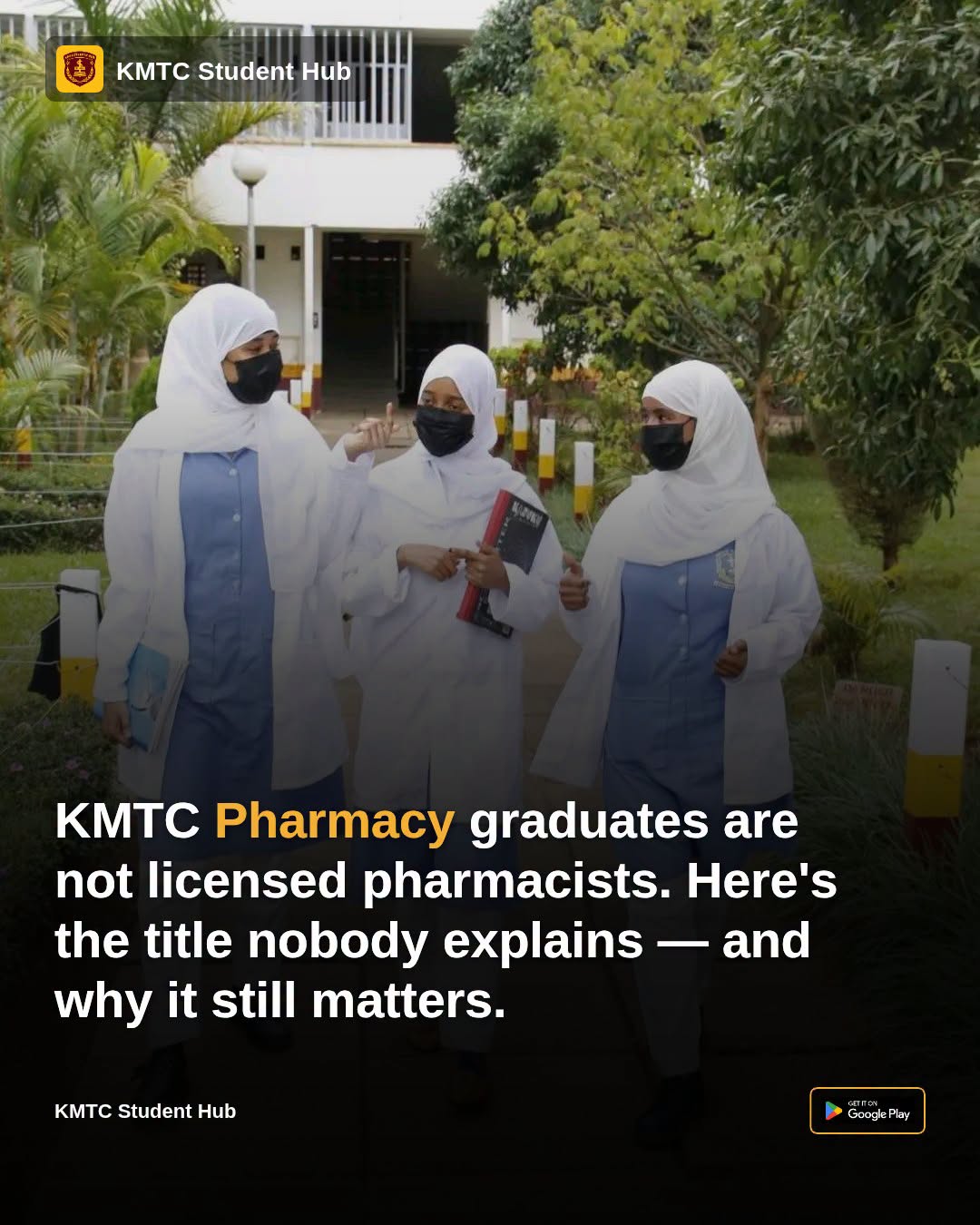
This is one of the most confused courses at KMTC. Let's clear it up properly.
MYTH vs REALITY
✗ MYTH: "KMTC Pharmacy graduates become pharmacists" ✓ REALITY: A diploma allows you to work as a Pharmaceutical Technologist. Becoming a licensed pharmacist in Kenya requires a Bachelor of Pharmacy degree. Different title. Different scope of practice. A KMTC diploma graduate is a Pharmaceutical Technologist, registered and licensed to practice — but not a pharmacist in the formal regulatory sense.
✗ MYTH: "There's a certificate level for Pharmacy at KMTC, just like other courses" ✓ REALITY: No, KMTC does not offer a certificate course in pharmacy. Certificate in Pharmacy is not recognised by the Pharmacy and Poisons Board of Kenya at all — which is why many institutions discontinued it entirely. Diploma is the only entry point. If someone tells you they're doing "Certificate in Pharmacy" at KMTC — that course does not exist there.
✗ MYTH: "Pharmacy is offered at most KMTC campuses" ✓ REALITY: According to the official Pharmacy and Poisons Board registry of approved institutions, KMTC offers this programme only at Nairobi, Nakuru, Kisumu, Nyeri, Manza, and Mombasa campuses. That's it. Six campuses nationwide. This is one of the most geographically limited KMTC diploma programmes — which is exactly why it's so competitive.
Entry requirements: A KCSE mean grade of C plain, with C in English or Kiswahili, C in Chemistry or Physical Sciences, C in Biology or Biological Sciences, and C in either Physics/Physical Sciences or Mathematics.
Who regulates this course: Registration is with the Pharmacy and Poisons Board. Not the Nursing Council. Not the Clinical Officers Council. The Pharmacy and Poisons Board specifically.
What you actually do as a Pharmaceutical Technologist: ✓ Dispense medication under pharmacist supervision or independently in community settings ✓ Manage pharmaceutical inventory and storage ✓ Counsel patients on medication use and drug interactions ✓ Support drug manufacturing quality control processes ✓ Assist in clinical pharmacy services within hospitals
Where you work after graduating: Public hospitals, private hospitals, mission hospitals, pharmaceutical industries, community pharmacies, research institutions, regulatory bodies, or self-employment.
If you want to go further: KMTC offers a Higher Diploma in Pharmacy — an 18-month advanced programme in Nairobi only, deepening knowledge in clinical pharmacy and herbal medicine, for those who already hold the diploma and want to specialise further.
Can you become a full pharmacist later? Yes. The Pharmacy and Poisons Board has approved a credit waiver policy, allowing diploma holders to transfer credits earned during diploma studies toward a Bachelor of Pharmacy degree. Your KMTC diploma is not a dead end — it's a recognized stepping stone if you choose to pursue full pharmacist licensure later.
KMTC trains highly competent Pharmaceutical Technologists — not pharmacists in the formal regulatory sense. Know the difference, know your exact title, and know your regulatory body. The course is only available at six campuses, which makes admission genuinely competitive — far more selective than many students realize.
Pharmacy students — did anyone clearly explain the Technologist vs Pharmacist distinction before you enrolled? Drop it below
Save this. Share with someone choosing Pharmacy at KMTC.
Free calculator
Browse all Kilelu calculators
Run your own numbers — no sign-up, right in your browser.
Related posts
- Certificate vs Diploma at KMTC — and HELB just opened applications for BOTH for the first time ever.
- HELB first-time applications close August 31. Here's what KMTC students specifically need to know.
- How much are KMTC fees in 2026? Full breakdown for government-sponsored students
- The government is building KMTC hostels. Students are dropping out because they can't pay fees.
- What KMTC freshers expect vs what actually happens in week one