
The Minimum Payment Warning Box You've Never Read (And What It Really Says About Your Debt)
 Debt Payoff Planner & Snowball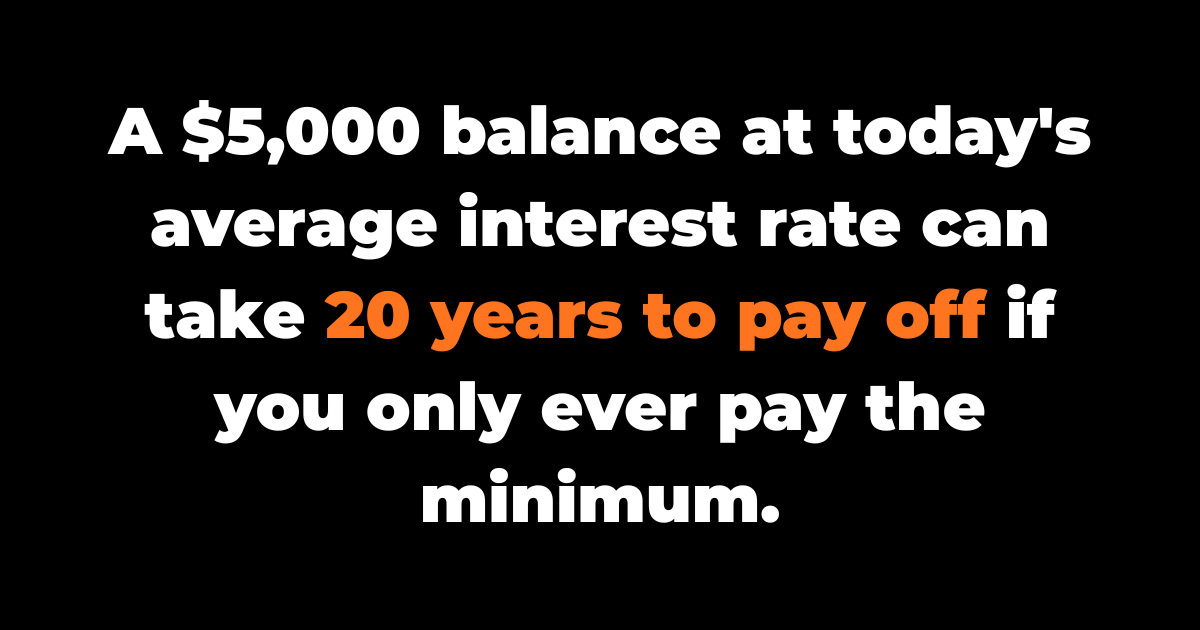
Paying your credit card bill on time every single month feels like proof you're handling your debt responsibly. Your account stays in good standing, you avoid late fees, your credit score doesn't take a hit. But none of that means you're actually getting out of debt — and the minimum payment is doing far less than most people assume.
Here's the actual math. The average American credit card balance right now sits at roughly $6,600 to $6,700, and the average interest rate on balances that carry over is around 22%. On a $5,000 balance at that rate, a typical minimum payment starts around $100 a month. If that's all you ever pay, it takes close to 20 years to clear the balance, and you'll hand over almost $7,000 in interest on top of what you borrowed — nearly $12,000 total for a $5,000 debt.
The reason it drags on that long isn't just the interest rate. It's that minimum payments are usually calculated as a small percentage of your remaining balance. So as you slowly pay it down, the minimum payment itself keeps shrinking too. You end up paying less each month, which stretches the timeline out even further. It's a moving target that's designed to move away from you.
There's actually a federal requirement that most people scroll right past. Since 2009, card issuers have been legally required to print a "minimum payment warning" box directly on every statement, showing exactly how many years minimum payments would take and what a 3-year payoff would cost instead. It's sitting on your statement right now. Almost nobody reads it.
The bottom line is this: staying current on a card and actually paying it off are two completely different things, and the gap between them is bigger than most people realize until they see the real numbers side by side.
Have you ever actually read the minimum payment warning box on your statement? What did it say your true payoff timeline was? 👇
Free calculator
Try the Debt Payoff Calculator
Run your own numbers — no sign-up, right in your browser.
Related posts
- "Only Paying The Minimum On Your Credit Card Isn't That Big Of A Deal"
- Making A Small Payment On Old Debt Is A Safe Way To Start Chipping Away At It
- Paying Off Your Smallest Debt First Is A Waste Of Money
- Closing A Credit Card Right After You Pay It Off Helps Your Credit Score
- 5 Ways To Live Debt Free